 Oahu Boat Tours
Oahu Boat Tours With Kids: Which Boat, and What to Expect
Last reviewed August 2026
None of the six Oahu boat tours compared on this site publish a hard minimum age, which sounds like good news for a family until it becomes clear that "no age limit" and "good for kids" are two different promises. Reading the six listings side by side for Oahu boat tours with kids turns up real differences: one boat states outright that it is family-friendly and safe for kids of all ages, two are stroller accessible, two offer discounted kids' rates, and one bars a whole category of medical conditions from boarding at all. This guide sorts the six by what they actually say about children, not by marketing language, and points to the boats that fit a toddler, a grade-schooler, or a teenager best.
Quick answer
No boat on this page states a minimum age, but the six listings differ sharply on what they actually promise a family: only one calls itself family-friendly and safe for kids of all ages, only two are stroller accessible, and only two publish a discounted kids' rate. The safest bet for a young or first-time child is the shortest, calmest sailing, not the cheapest or the most scenic one.
Key takeaways
- Only the Turtle Canyon snorkel with lunch states it is family-friendly and safe for kids of all ages, with life jackets provided for everyone aboard and infants riding on a parent's lap
- The $42.88 one-hour glass-bottom loop is the shortest, cheapest first boat for a young or nervous child, and nobody gets wet
- Two boats, the turtle snorkel catamaran and the whale watch, are stroller accessible; the other four don't state a stroller policy either way
- Kids get a discounted rate on both Turtle Canyon boats; the other four listings don't publish a kids' price
- Hawaii Nautical excludes travelers with heart problems or other serious medical conditions from its catamaran, the one clear medical line drawn on this page
- A rough day at sea affects a child faster than an adult; the honest playbook for that lives at the seasickness guide
Which Boat Fits Which Age
If You're traveling with a baby or toddler under 5
Favor the shortest exposure and the fewest moving parts: the $42.88 glass-bottom loop is one hour, stays dry, and needs no swimming. Two boats state stroller access, the turtle snorkel catamaran and the whale watch, and both let infants ride on a parent's lap rather than in a dedicated seat.
If Your child is 5 to 12 and comfortable in the water
The turtle catamaran with lunch is the only listing that calls itself family-friendly and safe for kids of all ages, with life jackets for everyone aboard and a discounted kids' rate. Its sibling boat, the turtle snorkel catamaran, matches it on price and adds a guaranteed turtle sighting or a full refund, useful if a child's first question afterward is going to be "did we actually see one."
If Your teenager wants something with more of a scene
The sunset splash cruise pairs an optional open-ocean swim with golden-hour views, and the once-a-week Friday fireworks cruise closes with a fireworks finale over Waikiki. Neither publishes a kids' rate, so budget the adult fare for a teen on either.
If Someone in the family has a heart condition or another serious medical condition
Hawaii Nautical's catamaran excludes travelers with heart problems or other serious medical conditions on its own listing, the one boat on this page with a stated medical line. None of the other five listings publish an equivalent exclusion, but none confirm the opposite either, so ask directly before booking.
Kid Facts, Boat by Boat
What each listing actually states about children
The table below is built strictly from what each operator's listing says, not from what seems reasonable to assume. Where a field says "not stated," that means the listing is silent on the point, not that the answer is no, worth confirming directly with the operator if it's the deciding factor for your family.
| Tour | Life jackets | Strollers / infants | Restrooms | Kids' pricing |
|---|---|---|---|---|
| Glass Bottom Boat Tour, $42.88, 1 hour | Not stated on the listing | Not stated on the listing | Not stated on the listing | Not stated on the listing |
| Waikiki Sunset Splash & Cruise, $60.64, 2 hours | Not stated on the listing | Not stated on the listing | Restrooms on board | Not stated on the listing |
| Friday Fireworks Cruise, $65, 2 hours | Not stated on the listing | Not stated on the listing | Not stated on the listing | Not stated on the listing |
| Turtle Canyon Snorkel with Lunch, $84.15, 2 to 3 hours | Provided for everyone aboard | Infants ride on a parent's lap; not wheelchair accessible | Not stated on the listing | Discounted kids' rate |
| Turtle Snorkel Catamaran, $59.99, 2 hours | Not itemized separately; premium snorkel gear provided | Stroller accessible | Two restrooms on board | Discounted kids' rate |
| Whale Watch, $49.95, 2 hours, December through May | Not stated on the listing | Stroller accessible; infants ride on a parent's lap | Not stated on the listing | Not stated on the listing |
The pattern behind the gaps
The two Turtle Canyon boats and the whale watch are the only three that address kids directly on their listings at all; the glass-bottom boat, the sunset splash and the fireworks cruise say nothing about children one way or the other. That's not automatically a red flag on a one-hour, dry, no-swimming boat like the glass-bottom loop, where there's little to state, but it's a real gap on a two-hour evening sailing with a cash bar and an optional open-ocean swim, where a parent genuinely benefits from knowing the rules before booking.
The Two Best First Boats for Kids
Glass-bottom boat: the lowest-stakes hour on the water
At $42.88 for one hour, the glass-bottom boat is the cheapest and shortest sailing on this page, and it's the only one where nobody gets in the water. That combination makes it the natural first boat for a toddler, a nervous child, or any family testing how a kid handles being on the ocean before committing to a longer sailing. The Haleiwa Queen runs the south shore from Kewalo Basin over live reef and one of Hawaii's shipwrecks, with turtles, eels and tropical fish visible from the deck as much as through the glass.
Turtle snorkel catamaran: the half-capacity option with a guarantee
The turtle snorkel catamaran, rated 4.9 from 1,756 combined reviews, sails at half capacity, a maximum of 28 travelers on a boat built for more, which means more deck space and less crowding around a child getting used to gear and a rocking boat for the first time. It's stroller accessible, has two restrooms on board, and backs its promise with a guaranteed turtle sighting or a full refund, so a family isn't paying $59.99 on the hope of a sighting that may not happen.
What the Listings Promise Families
Hawaii Nautical's family-friendly claim, checked
The turtle catamaran with lunch is the only one of the six that describes itself in these terms: family-friendly and safe for kids of all ages, with life jackets provided for everyone aboard and infants allowed to ride on a parent's lap rather than needing their own seat. Service animals are allowed. The same listing states the boat is not wheelchair accessible and runs as a barefoot cruise, meaning shoes stay at the pier for the whole sailing, worth knowing before a child who dislikes bare feet on deck boards.
A reviewer's daughter, entertained by the captain
One of the more specific data points on this page comes from a July 2026 review of the turtle snorkel catamaran. The reviewer, Fatima_T, wrote that her special-needs daughter stayed on the deck rather than snorkeling, and that the captain kept her entertained with fish food while the rest of the group was in the water. It's one review, not a policy, but it's a concrete example of a crew adapting to a child who wasn't going to do the main activity, the kind of detail that doesn't show up in a bullet-point listing.
Kids' rates exist, but only on two of six
Both Turtle Canyon boats, the turtle catamaran with lunch and the turtle snorkel catamaran, publish a discounted rate for kids. None of the other four listings mention a kids' price at all, which means a family budgeting for the glass-bottom boat, the sunset splash, the fireworks cruise or the whale watch should plan on paying the adult fare for every seat, child or not.
The Honest Limits
One boat excludes heart conditions outright
Hawaii Nautical's own listing for the turtle catamaran with lunch states plainly that the tour is not suitable for travelers with heart problems or other serious medical conditions. It's the one explicit medical exclusion across all six listings, and it applies to the whole party, not just the child, worth flagging if a grandparent or another family member with a heart condition is joining the trip.
Barefoot means barefoot
The same boat runs as a barefoot cruise: shoes come off and stay at the pier for the entire sailing. That's a minor detail for most kids and a real one for a child who is uncomfortable without shoes on a moving deck. None of the other five listings mention a barefoot policy, so it appears specific to this boat.
Seasickness hits kids faster than adults
None of the six listings make a child-specific seasickness claim, but the general pattern from reviews across the site is that motion affects a child's stomach before it affects an adult's, especially on a longer sailing or a rougher day. The Friday fireworks cruise lists motion-sickness prevention on its own what-to-bring list, which is as close as any operator here comes to naming the issue directly. The full breakdown of which boat rides calmest, when to sail, and what to pack for a queasy stomach lives at the seasickness guide, read it before booking a longer sailing for a child who gets carsick easily.
What a Day on the Water Feels Like for a Kid
Duration is the real variable, not the boat
The six sailings on this page run from one hour to three, and that range matters more to a child's patience than almost anything else in the comparison. The glass-bottom loop is over in an hour, which fits neatly around a nap schedule or a short attention span. The turtle catamaran with lunch runs two to three hours, long enough that a young child may be done with the novelty well before the boat turns back, worth pairing with a snack plan and a realistic expectation that the last thirty minutes may be more restless than the first.
The moments that hold a kid's attention
Across the reviews on this site, the moments that keep kids engaged are the concrete ones: a turtle surfacing near the boat, fish visible through the glass bottom, the captain narrating shoreline history past Diamond Head, or, on the fireworks cruise, the show itself lighting up over Waikiki. The quieter stretches, motoring out to a site or waiting for a snorkel group to finish, are the parts most likely to feel long to a young child, regardless of which boat it is.
| Age band | Realistic focused-attention window | What that means for a longer sailing |
|---|---|---|
| Toddler (2 to 4) | 20 to 30 minutes of active interest | Even the one-hour glass-bottom loop runs past this; expect a nap or a fuss near the end, not a full hour of engagement |
| Young child (5 to 7) | 30 to 45 minutes | The two-hour turtle boats will feel long in the middle stretch; the snack break and the swim itself are the anchor points to plan around |
| Older child (8 to 11) | 45 to 60 minutes | Comfortably covers the glass-bottom loop and most of a two-hour sailing, with a lull expected during transit time |
| Tween or teen (12+) | The full sailing, if the activity itself holds interest | Duration stops being the limiting factor; the deciding question becomes whether the boat's actual activity, snorkeling, sunset, fireworks, appeals to that age |
What to Pack for Kids
Sun and water basics
Reef-safe sunscreen only, and no spray sunscreens, applied before boarding rather than on deck, that rule comes directly from the Turtle Canyon listings and is worth following on any of the six boats, not just the ones that state it. A hat with a chin strap holds up better in the open-ocean wind than a loose one, and a rash guard covers a child's shoulders for a longer sailing without needing a sunscreen reapplication mid-trip.
Food and drink, boat by boat
What's provided varies more than most families expect. The turtle catamaran with lunch serves an island sandwich or wrap on its midday sailing, but only unlimited soft drinks on the morning run, pack a real breakfast before that one. The turtle snorkel catamaran offers snacks after the swim, plus water, soda and juice.
The whale watch provides nothing beyond what's sold on board, though BYOB snacks are allowed. The glass-bottom boat provides bottled water only. For a hungry kid, bring snacks regardless of which boat is booked.
Motion-sickness prevention, kept general
If a child is prone to carsickness, treat the boat the same way: whatever remedy works in the car, a wristband, a pharmacist-recommended tablet, an early meal rather than an empty stomach, apply it before boarding, not after symptoms start. Dosing for a child is a pharmacist or doctor conversation, not something to guess at dockside. The seasickness guide covers which of the six boats rides calmest and when to sail for the smoothest water, useful context before picking a longer sailing for a child who struggles with motion.
The family day-bag, boat by boat
What actually earns a spot in the bag depends on which boat is booked, since gear and food coverage vary so much across the six listings.
- Reef-safe sunscreen, no spray cans, applied before boarding
- A hat with a chin strap and a rash guard for a longer sailing
- A real breakfast before the turtle catamaran with lunch's morning departure, since only the midday sailing includes food
- Snacks from home for the glass-bottom boat and the whale watch, where nothing beyond drinks is provided
- A motion-sickness remedy that already works for the child, applied before boarding rather than after
- A light jacket for an evening sailing like the sunset cruise or the Friday fireworks cruise, where the temperature drops once the sun is down
- Closed shoes for the walk to the dock, even on the barefoot turtle catamaran with lunch, where shoes come off only once aboard
Every Boat, Kid by Kid
Glass-bottom boat: what the listing doesn't say, and what a parent reports anyway
Hawaii Glass Bottom Boat's own listing is silent on children, no life jacket line, no stroller policy, no kids' rate, which is unusual among the six but less risky than it sounds on a one-hour, fully dry sailing with no swimming and no gear. Nayeli's July 2026 review, written about the sailing generally rather than a child specifically, describes turtles and fish spotted easily from the deck, exactly the kind of low-effort wildlife moment that holds a young child's attention without requiring them to do anything but look.
Sunset splash cruise: an evening boat with an unstated policy
Pink Sails' listing states restrooms on board but nothing about children, strollers or kids' pricing, and the sailing itself, a two-hour evening cruise with a cash bar and an optional open-ocean swim off Diamond Head, is a different proposition than a daytime family sailing. The swim stop has no age limit stated, but it also has no supervision structure built for children the way the turtle boats do: no dedicated in-water guide, just a stairway down and an open hour. A parent bringing a strong young swimmer has more to work with here than a parent hoping the crew will manage a nervous one.
Friday fireworks cruise: a late night, not a kids' program
The fireworks cruise sails once a week and finishes after dark with a fireworks show, which is a genuine draw for an older child but a late night for a younger one. Like the sunset cruise, its listing doesn't address children, strollers or kids' rates directly; its own what-to-bring list mentions motion sickness prevention, worth planning around, since a two-hour evening sailing timed to end after a fireworks finale is a long stretch past a young child's bedtime on vacation.
Turtle catamaran with lunch: the listing built around families
This is the one listing among the six that states its family terms in full: family-friendly and safe for kids of all ages, life jackets provided for everyone aboard, infants riding on a parent's lap, service animals allowed. Leah_S's May 2026 review adds a concrete family data point: her kids had the best time, and the crew was attentive to dietary needs, useful for a family managing a food allergy alongside everything else on a two-to-three-hour sailing.
Turtle snorkel catamaran: the smaller boat with a guide in the water
At a stated maximum of 28 travelers, half the capacity the vessel could carry, this listing puts more deck space around a child getting used to gear for the first time, and it is stroller accessible where its sibling boat is not. Fatima_T's July 2026 review is the clearest evidence of how the crew adapts: her special-needs daughter stayed on the boat rather than snorkeling, and the captain kept her entertained by having her throw fish food to the fish, so she saw turtles and fish without ever leaving the deck, while the rest of the group snorkeled with a guide in the water beside them.
Whale watch: seasonal, stroller accessible, no swimming required
December through May only, this listing is stroller accessible and allows infants on a parent's lap, the same two family terms as the turtle catamaran with lunch, but it publishes no kids' rate and no life-jacket line specific to children. It's a dry, seated two hours, which removes the water-safety question entirely; the open variable is a young child's patience for a wildlife sighting that isn't scripted to happen on a schedule, discussed in the attention-span table above.
The Safety Layer, Boat by Boat
Life jackets: stated on one boat, unstated on the rest
Only the turtle catamaran with lunch states outright that life jackets are provided for everyone aboard. That doesn't mean the other five boats have none, marine operators in Hawaii carry Coast Guard-required safety equipment as a matter of law regardless of what a marketing listing states, but it does mean a parent who wants that specific reassurance in writing before booking has exactly one listing that gives it to them directly.
Guides in the water versus a crew on deck
On both turtle catamarans, a snorkel guide gets in the water with the group, the kind of hands-on supervision a nervous child benefits from most. The sunset cruise's swim stop has no equivalent structure stated, a stairway down and open water, with the crew watching from the boat rather than swimming alongside. For a family with a child who isn't a strong, confident swimmer, that distinction matters more than the price difference between the two kinds of sailing.
Stairway entries, not jumps
Every water entry described across the six listings, the turtle catamarans' snorkel stop and the sunset cruise's swim, uses a stairway down to the water rather than a jump or a ladder climb, a meaningfully gentler entry for a child than the deck-height jumps common on other Hawaii boat tours not covered on this page. It's a small detail, but it's the kind of detail that determines whether a nervous eight-year-old gets in the water at all.
What Kids Actually Remember
Read enough family reviews across these six listings and a pattern shows up: the moments kids talk about afterward are rarely the ones a marketing photo emphasizes. Feeding fish from the deck, watching a turtle surface an arm's length from the rail, and a crew member who noticed a specific kid and adapted to them, that last one especially, come up again and again, more than the boat itself or even the destination.
The fish-feeding moment
Fatima_T's account of her daughter throwing fish food from the deck while the captain kept her entertained isn't a scripted activity on the listing, it's a crew improvising around one child's situation. It's also, by the review's own account, the moment her daughter ended up loving the trip despite never getting in the water, a reminder that a child doesn't have to do the headline activity to have the memorable part of the day.
Turtles surfacing, not turtles underwater
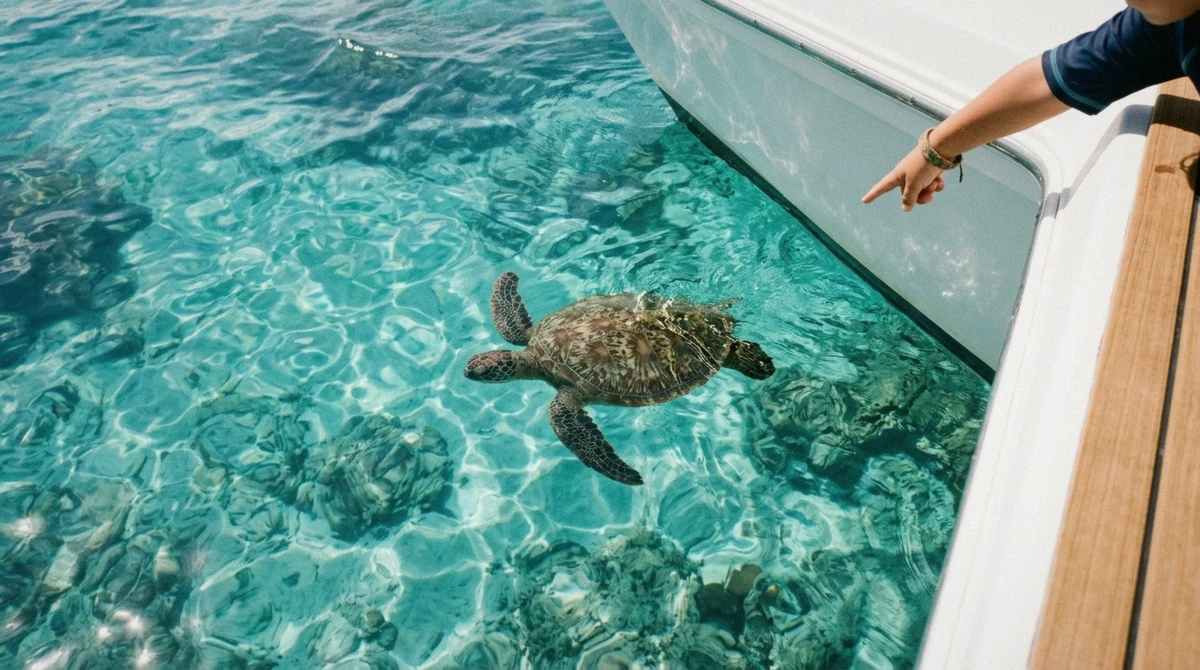
Across the reviews for both turtle boats and the glass-bottom boat, the turtle sightings kids and parents describe most vividly tend to happen at the surface, a turtle breathing right in front of the boat, rather than the underwater views a snorkel mask or a glass viewport technically provides. That's worth knowing for a family weighing the $42.88 glass-bottom loop against a $59.99 or $84.15 snorkel trip: a good share of what makes the turtles memorable doesn't actually require being in the water with them.
Snacks, Meltdowns, and the Middle of the Sailing
The hunger-meltdown window
The riskiest stretch on any of the six boats for a young child is the middle third of a longer sailing, past the initial novelty of boarding and before the activity that's the actual point, the swim, the snorkel, the fireworks. On the turtle catamaran with lunch specifically, that middle stretch on the morning departure is also the stretch with the least food: only unlimited soft drinks are included before the swim, no lunch, which is exactly the window where a hungry child is most likely to unravel. Packing a real breakfast and a snack that travels well solves most of it before it starts.
What actually calms a bored or overtired kid on deck
None of the six listings offer a kids' activity program, there's no craft table or games closet on any of these boats, so the entertainment on a slower stretch is whatever the crew improvises and whatever a parent brought. The fish-food trick from Fatima_T's review is one example of a crew filling that gap; a small pair of binoculars, a simple I-spy game for shoreline landmarks past Diamond Head, or letting an older child hold a phone for photos are lower-tech versions of the same idea, useful on any of the six boats regardless of whether the crew happens to have a similar trick that day.
No boat on this page turns a child away by age, but only one calls itself built for kids of all ages, only two are stroller accessible, and only two discount a child's seat. For a young or first-time child, the one-hour glass-bottom loop or the half-capacity turtle catamaran are the lowest-stakes places to start; for a family already comfortable on the water, the turtle boat with the family-friendly claim and the life jackets for everyone is the one built for exactly that trip. See how it stacks up against six Waikiki sailings compared side by side before booking.
Questions About Oahu Boat Tours With Kids
What is the best Oahu boat tour for young kids?
For the youngest or most nervous kids, the glass-bottom boat is the lowest-stakes choice: one hour, $42.88, dry the whole way, no swimming required. For a family ready for something longer, the turtle catamaran with lunch is the only listing that describes itself as family-friendly and safe for kids of all ages, with life jackets provided for everyone aboard.
Do kids get a discount on Oahu boat tours?
On two of the six: the turtle catamaran with lunch and the turtle snorkel catamaran both publish a discounted kids' rate. The glass-bottom boat, the sunset splash, the Friday fireworks cruise and the whale watch don't state a kids' price, so plan on the adult fare for those four.
Can I bring a stroller on an Oahu boat tour?
Two boats state they're stroller accessible: the turtle snorkel catamaran and the whale watch. The other four listings don't address strollers either way, so it's worth a direct question to the operator before assuming a stroller will fit on the boat or through the boarding gangway.
Are infants allowed on Oahu boat tours?
On the turtle catamaran with lunch and the whale watch, yes, both state that infants can ride on a parent's lap rather than needing a seat of their own. The other four listings don't mention an infant policy specifically.
Is there an age limit for the Turtle Canyon snorkel tours?
Neither Turtle Canyon boat publishes a minimum age. The turtle catamaran with lunch calls itself suitable for kids of all ages; the turtle snorkel catamaran doesn't state an age policy but does confirm stroller access, which points the same direction.
What if my child gets seasick on the boat?
None of the six listings make a child-specific seasickness promise. The general pattern is that a shorter sailing and a calmer boat lower the risk, the one-hour glass-bottom loop is the shortest exposure on this page. The full comparison of which boat rides calmest, what to pack, and where to sit is at the seasickness guide.
Which boat is calmest for a toddler who has never been on a boat before?
The glass-bottom boat is the safest first test: one hour, dry, no swimming, and the cheapest fare on this page at $42.88. If that goes well, the half-capacity turtle snorkel catamaran is a reasonable next step, with more deck space than a full boat and a guaranteed turtle sighting or a full refund.
Do the crews on the turtle boats get in the water with kids?
On both Turtle Canyon boats, yes, a snorkel guide gets in the water with the group. On the turtle snorkel catamaran, a July 2026 reviewer's special-needs daughter stayed on deck instead, and the captain kept her engaged with fish food rather than leaving her out of the experience entirely.
What should I pack for a hungry kid on the boat?
Snacks from home, regardless of which boat. Only the turtle catamaran with lunch's midday sailing includes an actual meal; its own morning departure offers unlimited soft drinks only, and the glass-bottom boat and whale watch provide just bottled water. A real breakfast before any morning sailing avoids the mid-trip meltdown window.
Does any Oahu boat tour have a kids' activity program?
No. None of the six listings on this page describe a structured kids' program, craft table or games closet. Entertainment on a slower stretch of the sailing comes down to what the crew improvises, like the fish-food trick one captain used to keep a non-swimming child engaged, and whatever a parent brings along, from binoculars to a simple shoreline spotting game.