 Oahu Boat Tours
Seasickness on Oahu Boat Tours: Which Boat Is Calmest
Last reviewed August 2026
Seasickness on Oahu boat tours is not evenly distributed across the six listings compared on this site, and the differences come down to real, checkable factors: hull type, sailing length, time of day, and how rough the water runs in a given season. One operator states outright that its catamaran is very stable and that most guests feel little to no seasickness. Another has a review describing half the boat seasick during a rough winter week. This guide ranks all six boats by motion exposure, explains why a catamaran rides flatter than a single-hull boat, and lays out the honest limits, including the one listing that excludes heart problems and other serious medical conditions from boarding at all.
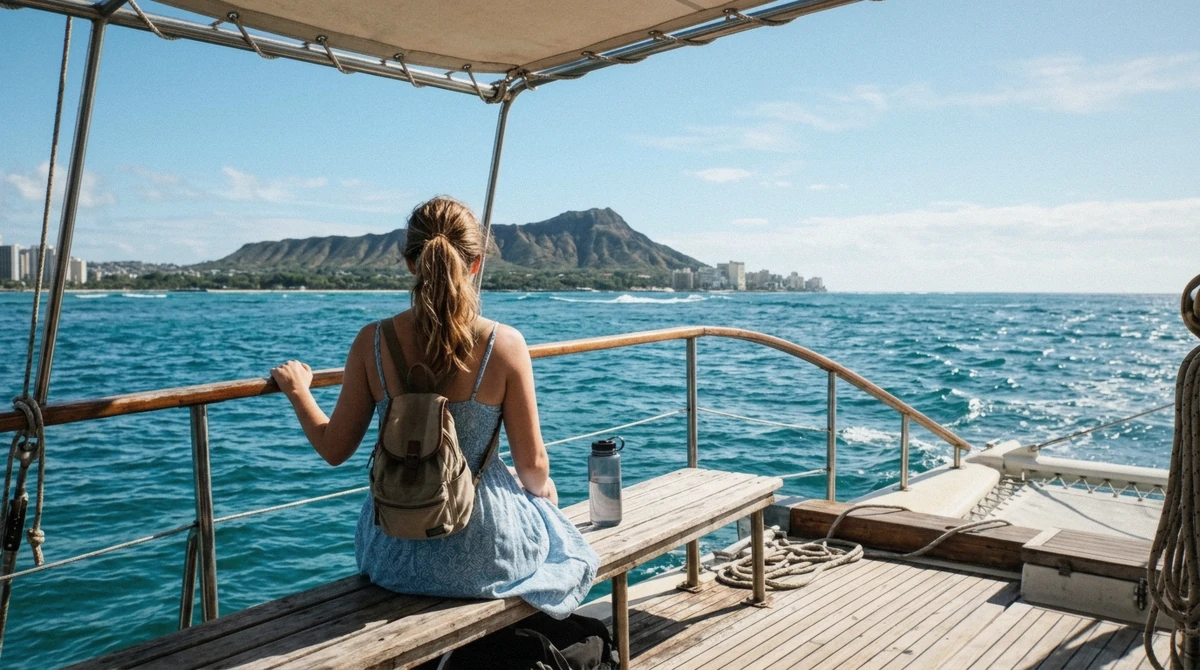
Quick answer
Catamarans ride flatter than single-hull boats, mornings run calmer than afternoons off the south shore, and the shortest sailing carries the least total exposure. Hawaii Nautical's own listing says its catamaran is large and very stable, with most guests feeling little to no seasickness, but one winter whale-watch review reports half the boat seasick in rough water, and that same season is the roughest time of year to sail.
Key takeaways
- The one-hour glass-bottom boat is the shortest sailing on this page, which makes it the shortest total exposure regardless of how the water is running that day
- Hawaii Nautical's listing states its catamaran is large and very stable and that most guests experience little to no seasickness, the strongest stability claim of the six
- Winter whale-watch water is the roughest on this page: a March 2026 review reports half the boat seasick, and the operator's own reply concedes it was a rougher week than usual
- Mornings run calmer than afternoons off Waikiki's south shore, since trade winds typically build through the day
- Travelers with heart problems or other serious medical conditions are excluded outright from Hawaii Nautical's catamaran, the one clear medical line on this page
- The Friday fireworks cruise puts motion-sickness prevention on its own what-to-bring list, a rare direct acknowledgment of the issue from an operator
Which Boat Fits Your Tolerance for Motion
If You get seasick easily, even on short ferry rides
Book the one-hour glass-bottom boat. It's the shortest sailing on this page, typically runs in the morning, and stays in sheltered south-shore water the whole way.
If You're unsure how you'll do but want to snorkel
Hawaii Nautical's turtle catamaran with lunch has the strongest stability claim of the six on its own listing: large, very stable, little to no seasickness for most guests.
If You're prone to motion sickness and want the evening cruises
The sunset cruise and Friday fireworks cruise both sail later in the day, when trade winds have built. Take any prevention step before boarding, not after, and expect more motion than a morning sailing.
If You have a heart condition or another serious medical condition
Hawaii Nautical's catamaran excludes this group outright on its own listing. None of the other five state a policy either way, so contact the operator directly before booking.
Catamaran vs Monohull: Why Twin Hulls Matter
The physics in plain terms
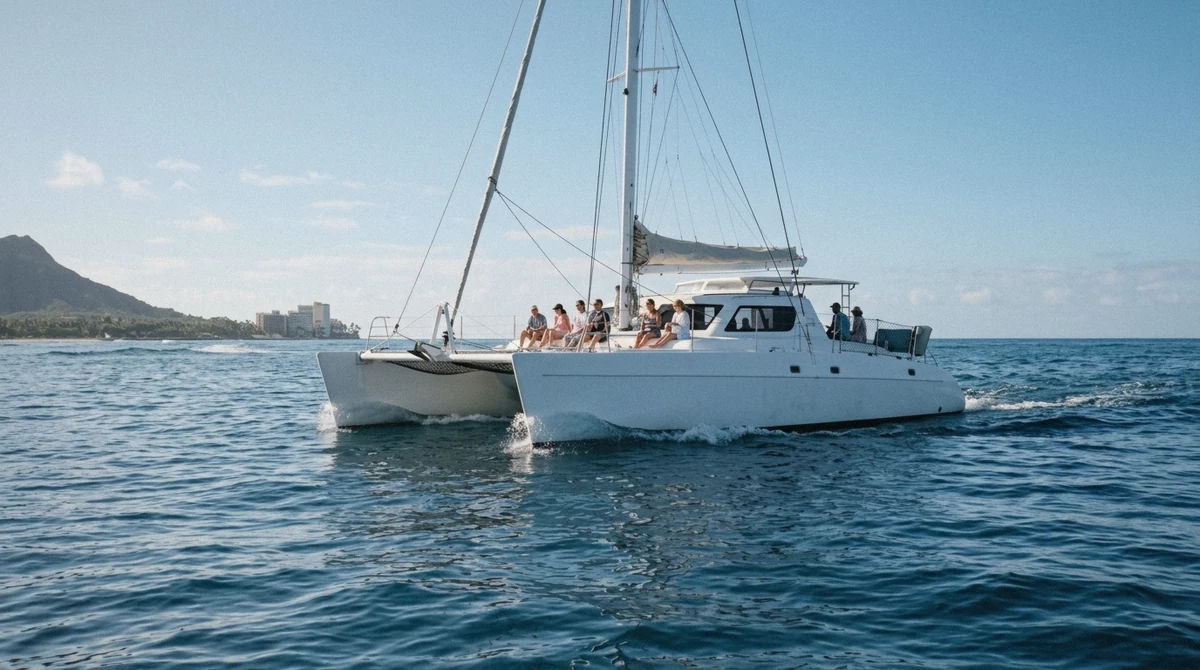
A catamaran rides on two hulls set apart from each other, which gives it a wider base and a lower center of gravity relative to its width than a single-hull boat of the same size. That wider stance resists the side-to-side roll that causes most seasickness, because the boat has to tip much further before either hull lifts clear of the water. A single-hull boat, riding on one narrower keel, rolls with the swell more freely, and that roll is exactly the motion that unsettles a stomach fastest.
What the listings on this page actually confirm
Three of the six boats are explicitly described as catamarans on their listings: the turtle catamaran with lunch, the turtle snorkel catamaran, and the glass-bottom boat, which runs on the Haleiwa Queen, itself a glass-bottom power catamaran. Hawaii Nautical's listing for the turtle catamaran with lunch goes further than most operators bother to: it states the boat is large and very stable, and that most guests experience little to no seasickness aboard it. That's a specific, checkable claim from the operator itself, not a generic reassurance.
The three boats without a stated hull type
The sunset splash cruise, the Friday fireworks cruise and the whale watch don't confirm a hull type on their listings. The sunset splash cruise's own listing is the most explicit about the uncertainty: it states that the boat assigned may be a pink double-decker or an open-style catamaran, subject to change by date, and that travelers commonly note the boat differs from the catamaran shown in the marketing photos. Rather than assume either boat rides flat, treat the timing and seasonal factors below as the more reliable guide for those three.
Where to Sit for the Steadiest Ride
Low, central, and facing the horizon
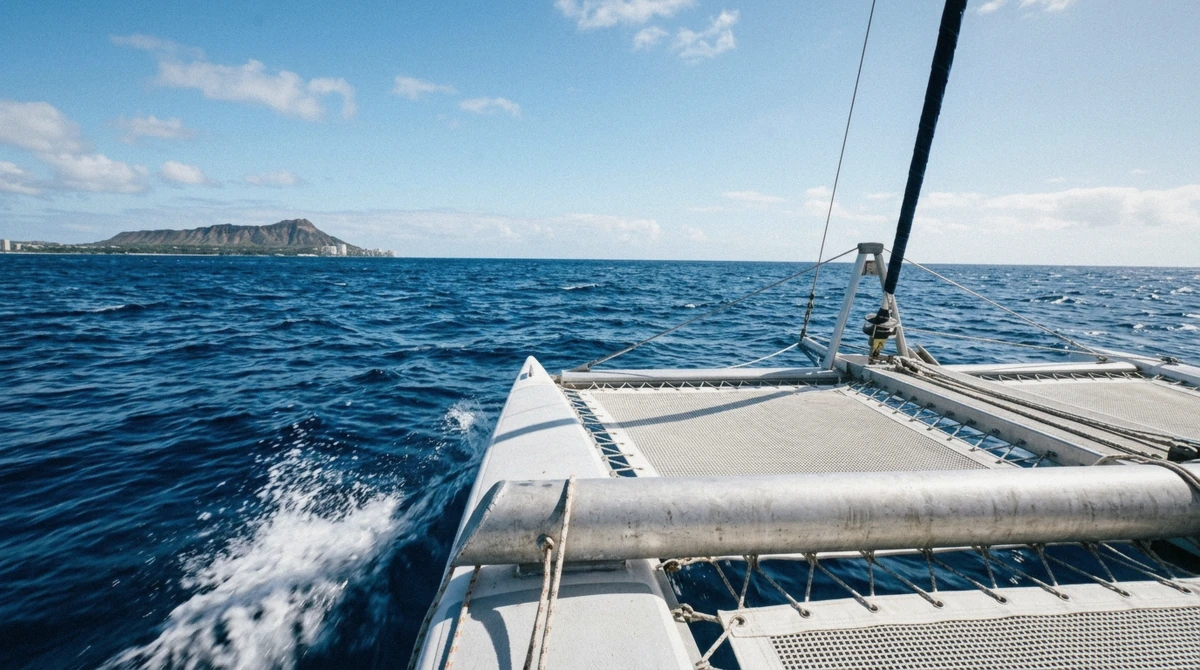
The general rule that applies on any boat, catamaran or not, is to sit as low and as close to the center of the vessel as the layout allows, the bow and the upper deck pitch and roll the most, while the center near the waterline moves the least. Keep your eyes on a fixed point on the horizon rather than on a phone, a book, or the water rushing past the rail; the mismatch between what your inner ear feels and what your eyes focus on up close is a large part of what triggers motion sickness in the first place.
Fresh air over an enclosed cabin
On boats with both an open deck and an enclosed cabin, the whale watch is built this way, with an upper observation deck and an enclosed lower cabin, the open deck is generally the better spot for anyone prone to seasickness. Fresh moving air and an unobstructed horizon both help; a warm, enclosed cabin with limited sightlines does the opposite for a queasy stomach, even though it's the more comfortable spot to escape sun or wind.
Morning or Afternoon: When to Book for a Calmer Ride
Trade winds build through the day
Off Oahu's south shore, mornings run calmer than afternoons, because the trade winds that Waikiki is known for typically pick up as the day goes on. A sailing that leaves at nine in the morning is, all else being equal, going to sit on flatter water than the same route sailed at three in the afternoon. That single fact does more to explain the difference between a smooth trip and a rough one than the choice of boat sometimes does.
What that means for each of the six
The glass-bottom boat and both Turtle Canyon catamarans commonly run morning sailings, which stacks a calmer time of day on top of a stable hull design. The sunset splash cruise and the Friday fireworks cruise sail by definition in the afternoon and evening, when the wind has had all day to build, one reviewer, Jennifer, described feeling seasick in rough evening waves on the sunset cruise in June 2026, though she still rated the trip five stars overall. The whale watch only operates December through May, months when winter swell adds a seasonal factor on top of any time-of-day effect.
| Time of day | Typical water condition off the south shore | Boats sailing then |
|---|---|---|
| Morning (roughly 8 to 11 AM) | Calmest window of the day, before trade winds build | Glass-bottom boat; typical departures for both Turtle Canyon boats |
| Midday (roughly 11 AM to 2 PM) | Wind beginning to pick up | The midday sailing option on the turtle catamaran with lunch |
| Afternoon (roughly 2 to 5 PM) | Trade winds typically at their strongest | Sunset splash cruise departures ahead of golden hour |
| Evening (after 5 PM) | Wind easing with sunset, but swell built through the day still present | Sunset splash cruise later departures; Friday fireworks cruise |
The Anti-Seasick Checklist
Before you board
Most of what actually prevents seasickness happens before the boat leaves the dock, not once symptoms start. This is a general prevention list, not medical dosing advice, talk to a pharmacist or doctor about what medication, if any, is right for you or your child.
- Take any motion-sickness medication before boarding, not after symptoms start, most work by preventing the reaction, not reversing it
- Eat something light beforehand; boarding on an empty stomach tends to make symptoms worse, not better
- Skip alcohol before and during the sailing where it's offered, several boats on this page serve drinks, and alcohol dehydrates and worsens motion sensitivity
- Ginger, in candy, tea or capsule form, is a widely used non-drug option worth packing
- Bring water and sip it steadily through the trip rather than large gulps
- Leave the book, the phone and the camera zoom lens for later, reading or focusing on a close object while the boat moves is one of the fastest ways to trigger symptoms
- Pick a seat low and near the center of the boat before it gets underway, rather than moving once you're already uncomfortable
- If you start to feel off, get outside into fresh air and fix your eyes on the horizon rather than heading into an enclosed cabin
The Six Boats, Ranked by Motion Exposure
From calmest exposure to roughest
This ranking combines what each listing states about hull type and stability, the typical time of day each boat sails, the length of the sailing, and what reviewers on that specific listing have reported about motion. It's a comparison built from real, checkable facts, not a guarantee of how any one sailing will feel on a given day, ocean conditions vary daily regardless of the boat.
| Rank | Tour | Vessel type | Duration | What tips the motion risk up or down |
|---|---|---|---|---|
| 1 (calmest) | Glass Bottom Boat Tour, $42.88 | Glass-bottom power catamaran | 1 hour | Shortest sailing on this page and typically morning departures; least total exposure even before hull stability is factored in |
| 2 | Turtle Snorkel Catamaran, $59.99 | Catamaran | 2 hours | Same sheltered south-shore route as the Turtle Canyon catamaran, typically morning sailings, half-capacity boat with more open deck space |
| 3 | Turtle Canyon Snorkel with Lunch, $84.15 | Catamaran; listing states "large and very stable" | 2 to 3 hours | Strongest stability claim of the six, but the longest of the daytime sailings, and the midday departure sits closer to the afternoon wind pickup |
| 4 | Waikiki Sunset Splash & Cruise, $60.64 | Boat type varies by date; pink double-decker or open-style catamaran | 2 hours | Afternoon-to-evening sailing when trade winds have built through the day; hull type not guaranteed; one reviewer reported seasickness in rough evening waves |
| 5 | Friday Fireworks Cruise, $65 | Not stated on the listing | 2 hours | Evening sailing after a full day of wind buildup; the only listing on this page that names motion-sickness prevention on its own what-to-bring list |
| 6 (roughest conditions) | Whale Watch, $49.95 | Not stated on the listing; upper open deck plus enclosed cabin | 2 hours | Sails only December through May, the roughest water season on this page; one March 2026 review describes half the boat seasick during a documented rough week |
Who Shouldn't Board: Heart Problems and Serious Conditions
One listing draws a clear medical line
Hawaii Nautical's listing for the turtle catamaran with lunch states plainly that the tour is not suitable for travelers with heart problems or other serious medical conditions. It's the only explicit medical exclusion across all six listings on this page, and it applies to seasickness-adjacent risk as much as to general fitness, a rocking boat and a queasy stomach are a real strain on anyone with a cardiovascular condition, which is likely part of why this particular operator states the exclusion outright while the other five don't.
The other five don't confirm either way
None of the remaining five listings publish a medical exclusion, but that's an absence of a stated policy, not a confirmed all-clear. If a heart condition, pregnancy, or another serious medical concern applies to anyone in your party, the honest move is to call or message the operator directly and ask, rather than assume a boat is fine simply because its listing doesn't mention a restriction.
Rough water is a real factor, not a rare one
The March 2026 review of the whale watch, from a reviewer named Shawn_R, describes half the boat seasick during that sailing, adding that whales were still seen despite the conditions. The operator's own reply to the review concedes it was a rougher week than usual, an honest acknowledgment rather than a denial, and useful confirmation that winter swell off Oahu genuinely varies week to week, not just boat to boat.
Why Boats Cause Seasickness: The Inner-Ear Conflict
A mismatch between what you feel and what you see
Seasickness is a form of motion sickness that comes down to a conflict between two of the body's own systems. The vestibular system in the inner ear constantly senses the boat rocking, rising and falling with the swell, while the eyes, especially when fixed on something close and stationary relative to the body, a phone screen, a book, the deck rail, report that everything around them is holding still. The brain receives two contradictory signals at once: motion from the inner ear, stillness from the eyes, and that unresolved conflict is what triggers the nausea, cold sweat and dizziness of seasickness.
It is not, physiologically, about a weak stomach; it's a sensory mismatch.
Why watching the horizon actually works
Fixing your eyes on a stable point on the horizon resolves the same conflict from the other direction. The horizon is the one visual reference outside the boat that genuinely doesn't move the way the deck does, so looking at it gives the eyes a signal that finally matches what the inner ear is already sensing: real motion, against a real fixed reference. That's the physiological reason behind the where-to-sit advice elsewhere on this page, it isn't a folk remedy, it's giving two conflicting senses the same information instead of two different ones.
Why it hits some people harder than others
Susceptibility to motion sickness varies significantly from person to person and even changes across a single lifetime, generally peaking in middle childhood and easing with age, though plenty of adults remain highly sensitive to it. None of the six listings on this page publish anything about individual susceptibility, since it isn't something any operator can control or predict, which is exactly why the prevention steps below focus on what a traveller can do before boarding rather than promising a symptom-free ride.
Medication and Timing: A General Guide
This is general prevention information, not medical or dosing advice. Talk to a pharmacist or doctor about what's appropriate for you or a child before your trip, especially if other medications or conditions are involved.
| Option | How it generally works | Timing |
|---|---|---|
| Antihistamine-type tablets | A class of over-the-counter motion sickness tablets that work by calming the inner-ear signal before it reaches the brain | Typically taken 30 to 60 minutes before boarding; most work by preventing the reaction rather than reversing it once it starts |
| Acupressure wristbands | A drug-free option that applies pressure to a point on the inner wrist; evidence is mixed but the appeal is no drowsiness and no interaction with other medication | Put on before boarding, left on for the full sailing |
| Ginger | A widely used non-drug option in candy, tea or capsule form, commonly used to settle stomach upset generally, not specific to boats | Most useful taken ahead of or early in the trip, before symptoms start |
The theme across all three options is the same one the checklist above makes explicit: timing matters more than the specific choice. Anything taken after symptoms have already started is working against a reaction that's already underway rather than heading it off, which is the single most common mistake travellers make with any of these options.
Per-Boat Motion Profiles, From What the Listings and Reviews Actually Show
Glass bottom boat: shortest exposure, dry conditions, sheltered route
The Haleiwa Queen is a glass-bottom power catamaran, so it carries the same twin-hull stability as the other catamarans on this page, combined with the shortest sailing time of any of the six at one hour. No review in the listing's traveler feedback mentions seasickness at all, the closest thing to a complaint is Lauren's note about the small viewing windows, unrelated to motion. The route stays along the sheltered south shore the entire way, never venturing into open water the way the whale watch or turtle-lunch boat can.
Sunset splash cruise: variable hull, evening timing, one documented rough sailing
This boat's own listing is the most upfront about hull uncertainty of the six: the vessel may be a pink double-decker or an open-style catamaran depending on the date, and travelers commonly note it differs from the catamaran pictured in marketing photos. Jennifer's June 12, 2026 review is the clearest data point on this boat specifically: "I got pretty seasick at the end because of some super rough up and down waves," during an evening sailing, still rated five stars overall. Nicole's July 27, 2026 review, by contrast, describes a calm evening with "lots of time for swimming," no motion complaint at all, underscoring how much day-to-day conditions vary on this particular route.
Friday fireworks cruise: hull not stated, evening timing, one direct complaint on record
No hull type is confirmed on this listing, and its own what-to-bring list names "motion sickness prevention" directly, a rare acknowledgment from an operator that the evening sailing can be rough enough to plan for. Maria's May 2, 2026 review confirms it isn't hypothetical: "I did throw up overboard so bring your nausea meds!!" written alongside an overall five-star review of the trip. This is the only one of the six listings that names motion sickness as a thing to prepare for in its own official guidance to travelers, which is worth taking seriously precisely because most operators don't volunteer that information.
Turtle snorkel with lunch: the strongest stability claim, longest sailing, mixed evidence in reviews
Hawaii Nautical's own listing states this catamaran is "large and very stable," and that most guests experience little to no seasickness aboard it, the single strongest operator claim on this page. Erin_H's August 2025 review adds a useful data point: she's someone who sometimes gets motion sickness, and reports it "didn't bother me at all" on calm water, while noting two other people on her sailing "were extremely sick," but had never been on a boat before, a detail suggesting inexperience rather than the boat itself was the bigger factor. At 2 to 3 hours this is also the longest of the daytime sailings, meaning more total time on the water even on a calm day.
Turtle snorkel, full refund: catamaran hull, shorter than the lunch boat, generally calm reviews with exceptions
Aaron_C's July 2026 review describes "rough seas" on his sailing and still calls the experience "a great time," while Melanie_P's July 2026 review reports conditions "a bit rough" but praises the crew for guiding everyone through it. Most reviews on this listing don't mention motion at all, consistent with the catamaran hull and the boat's typical morning departures, but these two rough-water reviews confirm that even a stable, well-regarded boat isn't immune to a choppy day.
Whale watch: hull not stated, seasonal timing, the roughest documented sailing on this page
No hull type is published for the Lahaina Princess, only that it offers an upper open deck and an enclosed lower cabin. One March 2026 review describes half the boat feeling seasick in rough winter water and advises queasy stomachs to pick a calmer morning, and Stacy_D's March 2026 review of a separate sailing independently describes the water as "pretty rough." Both reviews land in the same month, consistent with winter swell being a real, seasonal factor rather than a one-off. The operator's own reply to Shawn_R's review, "this may have been a rougher week than usual," is an honest concession rather than a denial.
What the Crews Actually Do for a Seasick Guest
Two boats on this page have documented, specific evidence of crew helping a seasick guest, not just a generic promise of good service. On the full-refund turtle snorkel, a featured review from Lauren_G describes it directly: "one of my group was getting nauseous/sea-sick, and the crew was able to help her out which was very appreciated." On the turtle-lunch catamaran, the operator's own listing states the policy outright rather than leaving it to a review to confirm: "If you start to feel unwell, our trained crew is happy to assist and will do their best to make you comfortable throughout the trip." Neither of these turns a rough sailing into a smooth one, but both are concrete evidence that a queasy guest isn't simply left to manage alone on these two boats specifically. None of the other four listings state a comparable policy either way.
After the Boat: Land Sickness and Mal de Debarquement
The rocking feeling that follows you onto the dock
Mal de debarquement, French for "sickness of disembarkation," is the lingering sense of rocking or swaying after stepping off a boat onto solid ground. It happens because the brain adapts to the boat's motion over the course of the trip, and that adaptation takes a little time to switch back off once the actual motion stops. For most people it's mild and fades within a few hours of returning to shore; a small number of people experience it for longer, though that's uncommon and unrelated to how seasick, if at all, someone felt during the sailing itself.
It isn't tied to any one boat on this page
None of the six listings address mal de debarquement directly, and there's no reason to expect it varies meaningfully between a one-hour glass-bottom cruise and a two-hour catamaran sailing, it's a general effect of time spent on moving water, not something specific to hull type or route. Anyone who's experienced it before on a cruise ship or ferry should expect the same possibility here, regardless of which of the six boats they choose.
Kids and Seasickness
Children's vestibular systems are still developing, and motion sickness susceptibility in kids generally peaks in the middle childhood years, often higher than in adults, though it varies widely child to child. Of the six boats, the turtle-lunch catamaran states it is "family-friendly and safe for kids of all ages," with life jackets provided for everyone aboard and infants riding on a parent's lap; both the full-refund turtle snorkel and the whale watch are stroller accessible. Fatima_T's July 2026 review of the full-refund turtle boat describes her daughter, who has special needs and chose to stay on the boat rather than snorkel, being kept entertained by the captain with fish-feeding rather than pushed toward the water, a useful example of a crew accommodating a child who wasn't comfortable rather than assuming every child handles the boat the same way.
None of the six listings publish specific guidance on children and motion sickness beyond general life-jacket and age policies, so the same prevention steps in the checklist above apply, timing any medication before boarding, a light meal beforehand, and a seat with a clear horizon view.
When to Use the 24-Hour Cancellation Window
All six boats offer free cancellation up to 24 hours before departure and reserve-now-pay-later booking, which matters specifically for anyone prone to seasickness, because it's the one real tool for dodging a known-rough day rather than gambling on it. A traveller who's already prone to motion sickness and sees a rough marine forecast, or simply wakes up to a stronger trade-wind day than expected, loses nothing by rebooking a morning sailing on a calmer day instead of pushing through an afternoon or evening one. The 24-hour window is tightest around the whale watch and the two evening cruises, the sunset splash and the Friday fireworks trip, since those are the three with the most documented rough-water reviews on this page; booking with a buffer of a day or two rather than a single fixed date gives that window room to actually be useful if the forecast turns.
More Dated Reviews on Motion and Comfort
Beyond the per-boat profiles above, these additional dated reviews add more specific, checkable detail on how motion actually felt aboard each of the six.
| Boat | Reviewer, month | What they reported |
|---|---|---|
| Turtle snorkel, full refund | Michelle_G, July 2026 | "Very easy trip to reef, good instructions on where to meet," no motion complaint on a route described elsewhere as generally calm |
| Turtle snorkel with lunch | Jason_C, April 2026 | Describes a longer wait at the dock before boarding but no seasickness once underway, with "drinks started flowing" during a smooth 15-minute ride out |
| Whale watch | Peggy_C, April 2026 | A calm-water sailing with no motion complaint, seeing dolphins and a mother-and-calf whale pair, evidence winter roughness isn't universal |
| Sunset splash cruise | SEIKO, May 2026 | No motion complaint, though cloud cover hid the sunset itself, a reminder that sea state and sky conditions are separate variables |
| Friday fireworks cruise | Wendy, May 2026 | "We had a blast" with no motion complaint noted, one of several fireworks reviews that don't mention sickness despite the boat's own what-to-bring warning |
Reading this wider set alongside the rough-water winter reviews reinforces the same conclusion: motion sickness on any of these six boats is real but inconsistent, tied more to a specific day's conditions than to a boat being reliably rough or reliably smooth. The listings and the reviews that mention hull type and stability claims are the most useful predictor available, but neither replaces watching the actual marine forecast close to a sailing date.
Common Assumptions Worth Checking
"A bigger boat is always steadier"
Not necessarily. Hull design and width matter more than sheer size. A wide catamaran rides flatter than a longer but narrower monohull of similar size, because the twin-hull stance resists roll regardless of overall length.
The whale watch, one of the larger vessels compared here by capacity, capped at 80 passengers and certified for 115, doesn't publish a hull type at all, and carries the roughest documented reviews on this page. Size alone isn't the reliable signal; hull design and route exposure are.
"If I didn't get seasick as a kid, I won't now"
Motion sickness susceptibility changes over a lifetime and isn't fixed. Someone who sailed comfortably as a child can develop more sensitivity as an adult, and the reverse happens too. Treating any of these six boats as automatically fine because of past experience on a different boat, in different conditions, skips the actual variables that matter here: hull type, time of day, and the specific day's swell.
"Medication guarantees a symptom-free trip"
No option on the medication and timing table above is described by its own category as a guarantee, only as a way to shift the odds. Ginger, acupressure bands and antihistamine-type tablets all work through different mechanisms and with different levels of evidence behind them, and none of the six boat operators claims their trip is symptom-free for every passenger. The honest framing, consistent with how the operators themselves describe it, Hawaii Nautical says "most guests," not "all guests," experience little to no seasickness, is odds improved, not odds eliminated.
Checking the Forecast Before You Sail
None of the six listings publish a live marine forecast, and this page doesn't track daily conditions either, but the pattern established across the dated reviews above gives a reasonable framework for checking one independently before a sailing. Wind speed and swell height are the two figures worth checking specifically: a forecast showing building trade winds through the afternoon lines up exactly with why the two evening sailings, the sunset splash and the Friday fireworks cruise, carry more documented rough-water reviews than the morning boats. A winter forecast with a larger swell height explains the seasonal pattern behind the whale watch's roughest reviews, all clustered in the same season the boat operates in.
Checking a general marine or surf forecast for Oahu's south shore the morning of a booking, alongside the free 24-hour cancellation window every one of these six boats offers, is a real, practical way to avoid the worst of a rough day rather than discovering it once already on the water.
Motion Risk vs Wildlife Odds: The Trade-Off on the Two Turtle Boats
Why the calmer boat isn't automatically the better choice
The full-refund turtle snorkel and the turtle-lunch catamaran cover the same reef, but they aren't interchangeable once seasickness enters the decision. The full-refund boat is the shorter of the two, two hours against the lunch boat's two to three, with a smaller 28-person cap against the lunch boat's 40. On paper that makes it the lower-motion-exposure option of the pair.
But the turtle-lunch boat carries the single strongest stability claim on this entire page, straight from the operator, and its midday sailing includes a real meal, which for some travellers, eating something substantial before or during a trip generally helps rather than hurts symptoms, is itself a mild seasickness advantage the shorter boat doesn't offer in the same way.
What this means in practice
Anyone choosing between the two turtle boats primarily on seasickness grounds is weighing a shorter sailing with a smaller group against a longer sailing with a more explicit stability guarantee and food included. Neither choice is wrong; it depends on whether total time on the water or hull stability and a full stomach matters more to a given traveller's own history with motion sickness.
A Word on Alcohol and Motion Sickness
Four of the six boats serve or allow alcohol aboard, the glass bottom boat (BYOB), the sunset cruise (cash bar), the fireworks cruise (two included drinks plus BYOB), and the turtle-lunch catamaran (complimentary beer, cocktails and wine on its midday sailing). Alcohol is a genuine seasickness risk factor in its own right: it dehydrates, and dehydration tends to worsen motion sensitivity rather than mask it, even though a drink can feel relaxing in the moment. None of the six listings warn about this directly, it's general knowledge rather than something specific to any operator, but it's worth factoring in specifically on the two boats where drinking is built into the experience, the sunset cruise and the turtle-lunch sailing, rather than treating the bar as a purely separate decision from the motion question.
Comparing the South Shore to Open Ocean Routes
Five of the six boats, everything except the whale watch, operate along Oahu's south shore, a naturally more sheltered stretch of water than the open ocean routes some boat tours elsewhere in Hawaii run. The whale watch, while still close to shore for most of its route, is built around finding humpbacks that migrate through open, deeper water, which is part of why its motion profile is the least predictable of the six even before winter swell is factored in. The four snorkel and sunset-and-fireworks boats staying closer to the sheltered coastline is a structural, checkable reason those routes tend toward calmer water on an average day, separate from any claim about hull type or operator skill.
If the First Ten Minutes Feel Rough
Motion sickness symptoms tend to build gradually rather than hit all at once, which means the first ten to fifteen minutes after leaving the dock are often the most useful window for course-correcting before things get worse. If the water feels choppier than expected right after departure, moving to a lower, more central spot on deck, finding the horizon, and stopping any reading, scrolling or photo-taking immediately, rather than waiting to see if symptoms pass on their own, is the single most effective real-time response available once already underway. On boats with an open deck, all six offer some outdoor seating, stepping outside into moving air rather than staying in a sheltered or enclosed spot also helps most people, even if it feels less comfortable in the moment than staying out of the wind.
The clearest pattern across all six listings: shorter sailings, morning departures, and catamaran hulls are the three levers that actually lower seasickness risk, and only one operator states outright who shouldn't board at all. Match the boat to the conditions rather than the price. See which Oahu boat fits your day for the full side-by-side, and let the anti-seasick checklist above cover the rest.
Questions About Seasickness on Oahu Boat Tours
Which Oahu boat tour is calmest for someone prone to seasickness?
The one-hour glass-bottom boat carries the least total exposure, since it's the shortest sailing on this page and typically runs in the morning. For a longer sailing, Hawaii Nautical's turtle catamaran with lunch is the strongest stability claim of the six, stating on its own listing that most guests feel little to no seasickness aboard.
Is morning or afternoon calmer off Waikiki?
Morning. Trade winds off Oahu's south shore typically build through the day, so an early sailing sits on flatter water than the same route in the afternoon or evening. The sunset splash and Friday fireworks cruise both sail later in the day for their views and finale, which is a real tradeoff against calmer water.
Where should I sit on a boat if I get seasick?
Low and near the center of the vessel, where roll and pitch are smallest, with a clear view of the horizon rather than a phone, book or camera. On boats with both an open deck and an enclosed cabin, like the whale watch, the open deck with fresh air is generally the better spot than the enclosed cabin.
What should I do if I start feeling seasick on the boat?
Move outside into fresh air if you're not already there, fix your eyes on a stable point on the horizon, and stop reading, scrolling or looking through a camera viewfinder. Sip water steadily rather than in large gulps. If symptoms started after boarding, it's generally too late for preventive medication to fully catch up, which is why the checklist above stresses taking it before departure.
Is it safe to go on an Oahu boat tour with a heart condition?
Hawaii Nautical's turtle catamaran with lunch explicitly excludes travelers with heart problems or other serious medical conditions. The other five listings on this page don't state a medical exclusion, but that's not a confirmed clearance either, contact the operator directly before booking if a heart condition applies to anyone in your group.
Can you still feel sick after the boat trip is over?
Mal de debarquement, the lingering sense of motion after stepping onto dry land, is a known effect of any boat trip and usually fades within a few hours. None of the six listings address it directly, since it's a general effect of time on the water rather than something tied to a specific boat's stability.
Does the whale-watching boat get rough in winter?
It can. The whale watch sails only December through May, the roughest water window on this page, and a March 2026 review describes half the boat seasick during one sailing, with the operator's own reply confirming it was a rougher week than usual. Most sailings aren't that rough, but winter conditions are the least predictable of the six boats compared here.
Does ginger actually help with seasickness on a boat?
Ginger, in candy, tea or capsule form, is a widely used non-drug option many travellers pack for motion sickness generally, most useful taken ahead of or early in a sailing rather than after symptoms start. It's one option among several on this page's medication and timing guide, not a substitute for medical advice if seasickness is a serious concern for you.
Can kids take seasickness medication on a boat tour?
Some options exist for children, but dosing and suitability vary by age and product, this page isn't medical guidance. Talk to a pharmacist or your child's doctor before your trip. On the water, the same non-medical steps apply to kids as adults: a light meal beforehand, a seat with a clear horizon view, and fresh air over an enclosed cabin.
What causes seasickness in the first place?
A conflict between the inner ear, which senses the boat's real motion, and the eyes, which report stillness when fixed on something close like a phone or a book. The brain receives two contradictory signals at once, and that mismatch is what triggers the nausea and dizziness, not a weak stomach.
Do any of the six Oahu boats let you rebook for free if you're worried about seasickness?
Yes, all six offer free cancellation up to 24 hours before departure and reserve-now-pay-later booking, which means a rough-forecast day can be rebooked rather than risked, at no extra cost, provided the change is made outside that 24-hour window.